ONLINE CASINO SCAMS The Independent UK Watchdog
Pattern Analysis

Casino scams follow a script: the seven stages of a rogue operator

Read enough complaints and the individual stories stop sounding individual. Brand names change, currencies change, games change — the order of events almost never does. A rogue casino is not improvising when it stalls a payout in week six; it is following a script that began with the advert clicked in week one. This analysis sets out the seven stages in order, names the tell at each one, and identifies the three points where the sequence can still be interrupted at no cost.

Seven identical brass casino chips stood on edge in a line and toppling like dominoes, the first two already flat, with a sprung mousetrap out of focus in the foreground
Section 01 / Why It Is a Script

Why the same story keeps arriving

The most useful thing about a rogue casino is how unoriginal it is. Complaints arrive from different players, in different months, about unconnected brands — and they describe the same events in the same order. That repetition is the signature of a business model refined by people who run it repeatedly, and who have learned which order extracts the most money before a player disengages.

Naming it a script matters practically. If a scam were a single act of dishonesty, the only available advice would be to avoid dishonest operators — advice nobody can act on. Recognise stage two and you have lost nothing; recognise stage six and you have usually lost everything you deposited. The stages below are drawn from the patterns behind this site’s rogue brand register and the models in the scam types hub. Not every operator runs all seven — where one is missing, it is because the operator judged it unnecessary, not because it improvised.
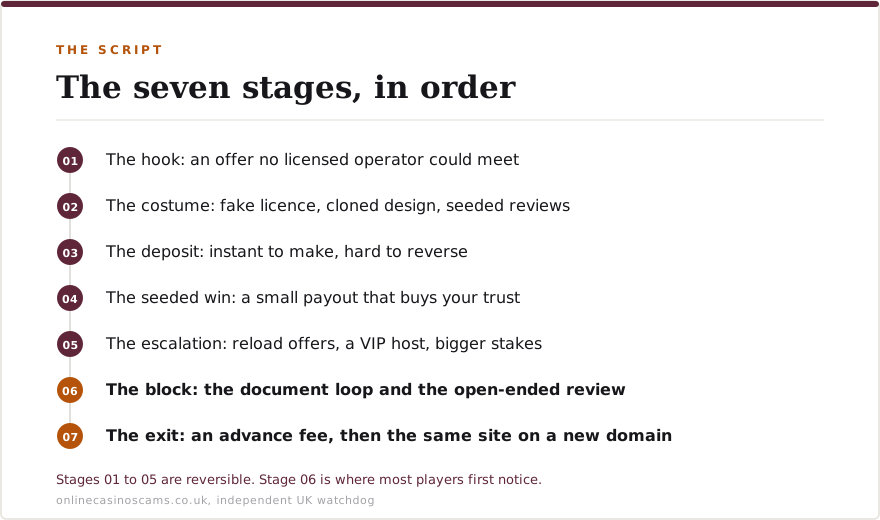
The seven stages of a casino scam in order: the hook, the costume, the deposit, the seeded win, the escalation, the block, the exit. Stages 1 to 5 are reversible; stage 6 is where most players first notice.
Section 02 / Stages 1 and 2

The hook and the costume

Stage one is an offer no licensed operator could profitably meet. A deposit match far above the market norm, free spins with no apparent condition, a bonus advertised as wager-free when the terms say otherwise. The number is not chosen to survive a careful reading — it is chosen to be the largest in a list of results, because the operator only needs the click. Generous offers exist legitimately, so the tell is not generosity but an offer unaccompanied by the conditions that would make it costly — the subject of our breakdown of bonus traps. The hook also arrives through channels a licensed operator may not use: unsolicited messages, or pages that appear to review casinos but rank only sites that pay them.

Stage two is the costume. Between the click and the deposit the site has one job — to look like something a reasonable person would hand a card number to. That work is visual and it is cheap. A licence badge that is an image rather than a link. A regulator that sounds official and either does not exist or does not cover the player’s market. A design copied from an established brand, sometimes on a domain one character off the real one — the mechanism behind cloned casino sites. Reviews posted in clusters, in similar phrasing, shortly after launch.

The asymmetry is the point — the costume costs very little, and the player is asked to make the entire judgement from it. The only reliable way through stage two is to check the operator against a source it does not control: the two-minute procedure in our licence check walkthrough.

Section 03 / Stages 3 and 4

The frictionless deposit and the seeded win

Stage three is a deposit that is easy to make and difficult to undo. Two things happen at once and only one is visible. The visible one is speed — money clears in seconds, nothing is verified, the account is playable immediately. The invisible one is the payment rail. Rogue operators consistently prefer cryptocurrency, vouchers and gift cards. The pitch is lower fees or greater privacy; the function is to remove the one party able to reverse the transaction on the player’s behalf — their bank.

This is where the cost of a mistake changes character. After a card deposit, a chargeback is at least a realistic route. After a crypto transfer or redeemed voucher, generally no mechanism exists to undo the payment. A site that declines cards and insists on irreversible methods is not offering convenience — it is closing the exit before the player knows one is needed.

Stage four is the small win that gets paid. It is the most effective stage in the script. A modest withdrawal, often the first requested, is processed quickly. It is not an operator error — a paid withdrawal turns a wary customer into a confident one and establishes the belief that makes the next stage work. Some run it at a controlled cost, paying anything small while stalling anything that matters; others seed early wins through unlicensed games with altered payout behaviour, examined in our analysis of rigged and pirated games. One paid withdrawal is evidence about one withdrawal — not about the operator.

Section 04 / Stage 5

The escalation

Stage five raises the amount at stake. Once a player has deposited and been paid once, the objective shifts from acquiring them to increasing their exposure. The methods are ordinary marketing without the constraints a licensed operator works under — reload offers timed to arrive after a loss, cashback framed as a refund, an account manager making contact with negotiated offers, tiered status lost if depositing stops.

What separates this from lawful promotion is the absence of brakes. A Gambling Commission licensee is answerable for offers that push a player beyond what they can sustain. An unlicensed operator has no such duties — escalation continues for as long as the player keeps paying. This is also where the terms accepted in stage one become load-bearing. Wagering multiples, capped wins, excluded games and minimum-bet rules go unenforced while money is arriving — then are invoked when it stops. The clause nobody mentions for two months is the clause cited in stage six.

Section 05 / Stages 6 and 7

The block and the exit

Stage six is the block, and it is triggered by size rather than by time. It does not begin when a player becomes suspicious — it begins when a withdrawal is large enough to be worth refusing. What follows is rarely a refusal, because a refusal is a decision a regulator can examine. Instead the payout meets obstacles, each individually defensible as procedure: documents requested one at a time rather than together, uploads declared unclear and resubmitted, an open-ended review with no completion date, or a pending withdrawal quietly reversed into playable funds.

Every delay is framed as something the player must fix — and the finish line moves each time they reach it. Genuine verification is a legal requirement: it asks for a defined set of documents once and confirms them within a stated window. A loop with no end is not verification. Our guide to withdrawal traps takes each tactic apart individually.

Stage seven is extraction, then departure. With the payout blocked, some operators attempt one further collection — a fee to release the winnings, a verification deposit, a tax or insurance payment to unlock a large win. The framing varies; the structure does not. It inverts how a withdrawal works — a real payout is deducted from a balance and sent to the player, never funded by a new payment from them. No version of this is legitimate, and each fee paid only triggers the next. Departure then takes one of two forms: the site stops responding and reappears under a new name with the same template, or someone offers to recover the funds for an upfront fee — a second script rather than the end of the first, documented under recovery scams.

Section 06 / The Same Script Abroad

The stages travel; the defences do not

The seven stages are not a British phenomenon. What changes between jurisdictions is never the sequence — it is the costume in stage two and the recourse at stage six. Verification advice therefore has to be written per market, because a player following another country’s guidance will look for a licence that does not apply to them.

Anyone searching for safe online casinos Canada players can use meets a sharper version of that problem, because there is no single national licence equivalent to a Gambling Commission entry. Ontario runs its own regulated market through iGaming Ontario, other provinces channel legal play through their own lottery corporations, and a large offshore sector sits outside both. That structure gives an operator more room in stage two — with no one register a player can simply be pointed at, an irrelevant or invented regulator is harder to falsify at a glance. On the distinction that actually matters there, according to the National Post, the meaningful separation is between provincially regulated sites, offshore operators holding a recognised licence, and offshore operators holding nothing at all.

For readers here the useful point is narrower. A brand that fails stage two in one market usually fails it in all of them, because template, terms and payment rails are shared across an operator’s domains. The check is portable even when the register is not — whatever the jurisdiction, the question is whether an authority covering the player’s own location names this operator and this domain.

Section 07 / Breaking the Script

Three points where the sequence stops

The stages are not equally expensive to reach. Recognition before stage three costs nothing, recognition at stage four costs whatever has been deposited, and recognition at stage six is a recovery problem — not a prevention one.

  • At stage two, check the operator somewhere it has no control. The footer badge, the about page and the reviews a site links to are all authored or bought by the operator — a licence entry is not. Find the operating company named in the footer on the register covering your jurisdiction, then confirm the exact domain appears in that licence. Both halves matter — a real licence does not automatically cover every site its holder runs. The Gambling Commission publishes player guidance at gamblingcommission.gov.uk.
  • At stage three, choose a payment rail you can reverse. The cheapest insurance in the process, and entirely within the player’s control. A card payment can be disputed through a chargeback; a crypto transfer or redeemed voucher generally cannot. Treat pressure toward irreversible methods as a finding in its own right — not a payment preference.
  • At stage four, do not revise your assessment on one paid withdrawal. The evidence feels strong and is genuinely real — the operator did pay. What it does not establish is anything about a payout large enough to be worth blocking. If the licence check was skipped, a small successful withdrawal is the moment to run it.

If the sequence has already reached stage six, the response depends on whether the operator holds a licence in your jurisdiction. With a Gambling Commission licensee, deliberate obstruction breaches licence conditions, and there is a defined ladder — a written complaint, escalation to its named alternative dispute resolution scheme, then the regulator, set out in our guide to complaints and ADR. With an unlicensed site there is no dispute scheme and no authority over an offshore shell, so a bank chargeback is the main realistic channel and speed matters. Either way the first action is free — screenshot the balance, the pending withdrawal, every message and the terms as they read today.

None of this requires identifying a scam in the abstract — the part players are usually asked to do and cannot. It requires noticing which stage is in progress.

Section 08 / Questions

Frequently asked questions

How the stages present in practice, why an early payout proves less than it appears, and what changes once a withdrawal is blocked.

Do all scam casinos follow the same seven stages?

Not every operator runs every stage, but the order is stable. Outright fake sites often skip the seeded win because they never intend to pay anyone, and a licensed operator behaving badly may only reach the block. Where a stage is missing it is usually because the operator judged it unnecessary — not because it improvised. The sequence is what makes early recognition possible.

The casino paid my first withdrawal. Does that mean it is legitimate?

It means that one withdrawal was paid. Paying small amounts quickly is a deliberate stage in the script — it converts a cautious new player into a confident one and produces positive reviews that dilute the negative ones. Some operators pay anything small while stalling anything large enough to matter. A successful small payout is a good moment to run the licence check — not a reason to skip it.

Why do rogue casinos push crypto, vouchers and gift cards?

Because those payments cannot be reversed. A debit or credit card payment can be disputed through a chargeback; a cryptocurrency transfer or a redeemed voucher generally cannot be undone by anyone. When a site declines cards and presses for irreversible methods as faster, cheaper or more private, it is removing your bank from the process — before you know you need it.

A casino wants a fee to release my winnings. Is that ever genuine?

No. No legitimate casino requires a payment from you to release a withdrawal. Release fees, verification deposits, taxes and refundable bonds to unlock a win are the same advance-fee structure — each payment triggers the next and the balance is never paid. A real withdrawal is deducted from your balance and sent to you, never funded by a new payment from you.

Does the script work the same way outside the UK?

The stages are the same — what changes is the costume and the recourse. In markets without a single national register, such as Canada with its provincial structure, there is no one authority a player can be told to check, which gives an operator more room to display an irrelevant or invented regulator. Verification advice has to be written for the player’s own jurisdiction rather than borrowed from another.

My withdrawal is already blocked. What should I do first?

Document everything before anything else — the balance, the pending withdrawal, every support message and the terms as they read today. Then the route depends on the licence. For a Gambling Commission licensee, complain in writing, escalate to its named ADR scheme, then the regulator. For an unlicensed site, report it and treat a bank chargeback as the main realistic channel, asking early because time limits apply.

Section 09 / Keep Reading

Related reading

The sequence is easiest to stop before the first deposit.

Stages one to three happen before any money is at risk, and all three are visible from the outside. Verify the operator on the register that covers your jurisdiction, confirm the exact domain, and pay by a method your bank can reverse.