ONLINE CASINO SCAMS The Independent UK Watchdog
Recovering Your Funds

Getting money back from an online casino: the honest version

A gambling refund is sometimes possible and sometimes not, and the difference is entirely about which situation you're in — not how persuasive your complaint is. This guide sorts the four common scenarios from strongest to weakest, explains how debit-card chargebacks and Section 75 credit-card protection actually work, and tells you plainly where money back simply isn't available. We won't promise outcomes nobody can promise. The aim is to point your effort at the route that can work and away from the ones that waste time — or cost you a second loss.

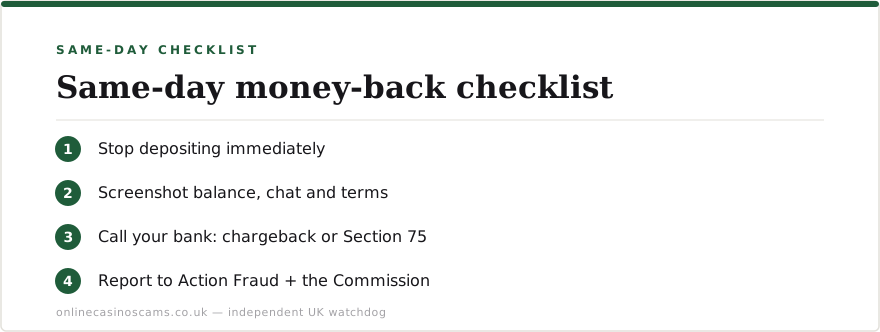
Same-day money-back checklist: Stop depositing immediately; Screenshot balance, chat and terms; Call your bank: chargeback or Section 75; Report to Action Fraud + the Commission.
Section 01 / Which Case Are You In?

First, which situation are you actually in?

Almost every "how do I get money back from an online casino" question is really one of four very different situations, and the realistic answer changes completely between them. Work out which one applies before you do anything else.

  1. Unauthorised transactions, or a site that never delivered / was outright fraudulent. This is the strongest position. If charges were taken without your authority, or the operator took deposits and never provided the service it advertised, you have a genuine fraud or dispute claim — pursued through your bank's chargeback or fraud process. A gambling refund is most realistic here because the issue isn't gambling at all; it's a payment that shouldn't have happened.
  2. Deposits to an unlicensed operator. Middle ground. A site with no right to serve GB customers gives you an arguable "services not as described" or fraud angle, but the outcome rests on your bank's discretion. Document everything; the unlicensed status is your central argument.
  3. You gambled at a licensed casino and lost. The hard truth: losses from legitimate gambling at a properly licensed operator are not refundable. The service — the wager — was delivered. Banks will not reverse a loss simply because you regret it, and no honest guide should suggest otherwise. Knowing this early saves you from chasing a refund that doesn't exist.
  4. A licensed casino is withholding your winnings. This isn't a refund problem at all. You're not trying to claw back a deposit — you're owed a payout. That's the complaints and adjudication route, not the bank, and it has its own machinery. See complaints and ADR.

The rest of this guide focuses on cases 1 and 2, where a gambling refund can be genuinely worth pursuing, and is candid about case 3, where it isn't.

Section 02 / Debit-Card Chargebacks

Chargebacks on debit cards

A chargeback is a dispute you raise with your own bank, which then asks the card scheme (Visa or Mastercard) to reverse a transaction under the scheme's rules. It isn't a legal right in the way Section 75 is — it's a scheme process — but for debit-card payments it's often the only mechanism available, and it can work where the facts support a clear dispute reason.

The time limit matters. Card-scheme chargeback windows are commonly described as running around 120 days from the transaction (or from when you became aware of the problem, depending on the dispute reason) — but exact limits vary by scheme and reason, so confirm the deadline with your bank rather than relying on a round number. The practical takeaway is the same either way: raise it early. Delay is the most common reason a viable claim dies.

When you contact the bank, be precise about the dispute reason rather than emotional about the loss. The strongest framings are that the transactions were unauthorised, or that the merchant did not provide the service as described — particularly relevant where the operator had no licence to offer that service to you at all. Avoid framing it as "I gambled and want my money back", which invites a quick refusal.

Evidence that helps: dated screenshots of the deposit and your account balance, the transaction history, any chat or email with the operator, and — crucially — proof that the operator does not appear on the Gambling Commission register for GB customers. Our licence walkthrough shows exactly how to capture that evidence. Be realistic: chargebacks for gambling-related transactions are discretionary and frequently disputed, and the bank may decline. A well-documented claim raised quickly is simply the version most likely to be heard.

Section 03 / Section 75 on Credit Cards

Section 75 on credit cards

If you paid by credit card, a different and generally stronger protection exists. Under Section 75 of the Consumer Credit Act, your card provider can be held jointly liable with the merchant for a breach of contract or misrepresentation — for single transactions where the item or service cost more than £100 and no more than £30,000. This is a statutory right, not a scheme courtesy, which is what makes it more robust than a chargeback when it applies.

Joint liability means you can pursue the card provider directly, as though it were the trader. Where an operator misrepresented its service or took payment it had no right to take, that can be a real lever. The £100-£30,000 band is the key gate: it's the value of the relevant transaction that matters, and there's well-established case law around how the threshold works, so it's worth raising the claim and letting the provider assess it.

The honest caveat for gambling specifically: many card issuers treat gambling deposits as a cash-like transaction (a "cash advance") rather than a purchase of goods or services, and the application of Section 75 to gambling deposits is not uniform. Issuers vary in how they handle it. We're not going to pretend there's a guaranteed answer here — there isn't. But where you paid by credit card, raising Section 75 alongside, or instead of, a chargeback is worth doing, because the joint-liability angle is one your provider must actually consider.

Section 04 / The Unlicensed-Operator Angle

Why "the operator was unlicensed" strengthens your claim

The single most useful fact you can bring to any dispute — chargeback or Section 75 — is that the operator had no right to serve GB customers in the first place. It reframes the whole conversation. You are no longer a player asking to undo a loss; you are a customer who paid a business that was operating outside the system meant to authorise it. "Services not as described" and misrepresentation arguments rest much more naturally on that footing.

This is where documented evidence does real work. Confirm the operator is absent from the Gambling Commission register using the licence walkthrough, and capture it with dated screenshots. Where our own register has documented a UK-facing operator as unlicensed, that record adds weight to the picture — for example, our entry on Winner documents an operator marketing to GB players outside the licensing system, and according to that register record its behaviour fits the pattern this section describes. Attribute what you cite, keep your own copies, and let the bank weigh it.

None of this guarantees a refund. Bank discretion is still bank discretion. But "unlicensed operator, here's the proof" is a materially stronger opening than anything built on the gambling itself, which is exactly why it belongs at the centre of your claim.

Section 05 / What Never Works

What never works — and what makes things worse

Some routes don't just fail; they actively cost you more. Avoid all three.

  • Paid "recovery agents" and fund-recovery companies. Anyone who contacts you offering to recover your gambling losses for an upfront fee or a cut is running the second wave of the scam — they target people who have just lost money precisely because they're desperate to recover it. There is nothing they can do that you can't do yourself for free through your bank, Action Fraud and the regulator. Read how the play works on our recovery scams page before you reply to a single one of them. This is a hard warning: paying a recovery agent is how a single loss becomes two.
  • Threatening the casino. Demands, abuse or threats to a rogue operator achieve nothing except handing it a reason to ignore you, and they can compromise a later complaint. With a licensed casino, escalate through the proper ladder instead; with an unlicensed one, your leverage is the bank, not the operator.
  • Gambling the balance back. Chasing a loss with more deposits is the exact behaviour rogue sites are engineered to produce. It doesn't recover anything; it deepens the hole and weakens any claim you might make. Stop depositing the moment something feels wrong.
Section 06 / The Same-Day Checklist

The same-day checklist, in order

If you've decided your situation is one where a gambling refund is realistic, move quickly and in this sequence — it preserves your strongest options.

Stop depositing

No more money into the account, full stop. This protects both your funds and your claim.

Screenshot everything

Balances, transaction history, chat logs and the terms as they read today — they change. Capture the licence-register absence too.

Call your bank

Raise a chargeback (debit) or Section 75 claim (credit) with a precise dispute reason. Ask the bank to confirm your deadline.

Report and keep records

Report to Action Fraud and the Gambling Commission, then keep copies of everything you submit.

On the reporting step: report unlicensed operation to the Gambling Commission and losses to Action Fraud. Reports build the enforcement record even where they can't reverse your own loss — and the case reference is useful documentation for your bank. The complaints-and-ADR route is the right channel when a licensed casino is the problem; see complaints and ADR for that path. Then keep every email, reference number and screenshot in one place. Disputes are won on records, not on insistence.

Section 07 / Questions

Frequently asked questions

What you can realistically recover from a casino, when chargebacks work, and what never does.

Can I get a gambling refund?

Sometimes. A gambling refund is realistic where transactions were unauthorised, where the operator never delivered the service, or — more arguably — where you deposited with an unlicensed operator. It is not available simply because you lost money gambling at a properly licensed casino. The honest answer depends entirely on which of those situations applies to you.

How do I get money back from an online casino?

Work out your situation first, then use the matching route: a debit-card chargeback or a Section 75 credit-card claim through your bank, supported by dated screenshots and proof of the operator's licence status. Stop depositing, document everything, call your bank promptly, and report to Action Fraud and the Gambling Commission. None of it guarantees a refund, but it's the version most likely to work.

How do casino chargebacks work?

A casino chargeback is a dispute you raise with your own bank, which then applies the card scheme's rules to try to reverse the transaction. You give a dispute reason — unauthorised payment, or service not as described — plus evidence. The bank decides at its discretion, and gambling-related chargebacks are frequently disputed, so raise it early and frame it precisely.

What is Section 75 and does it cover gambling deposits?

Section 75 of the Consumer Credit Act makes your credit-card provider jointly liable with a merchant for breach of contract or misrepresentation on transactions costing £100 to £30,000. That's well established. Its application to gambling deposits is less settled — many issuers treat gambling deposits as cash-like rather than a purchase, and issuers vary — so it's worth raising a Section 75 claim, but no outcome is guaranteed.

Can I get a refund if I lost at a licensed casino?

No. Losses from legitimate gambling at a properly licensed operator are not refundable — the wager you paid for was delivered. Banks will not reverse a loss because you regret it, and any service promising to recover ordinary gambling losses is misleading you. Managing that expectation is part of staying safe.

The casino was unlicensed — does that help my claim?

Yes, materially. If the operator had no right to serve GB customers, your dispute shifts from "I gambled and lost" to "I paid a business operating outside the licensing system" — a much stronger basis for a services-not-as-described or fraud argument. Capture the register absence with the licence walkthrough. It still rests on bank discretion, but it's your best lever.

How long do I have for a chargeback?

Card-scheme chargeback windows are commonly described as running around 120 days from the transaction, but the exact limit varies by scheme and by dispute reason. Treat 120 days as a rough guide only and confirm your actual deadline with your bank. Either way, raise it as early as possible — delay is the most common reason a viable claim fails.

Will my bank refund gambling I regret?

Not on the basis of regret alone. A bank can act where a transaction was unauthorised or a service wasn't delivered, but it will not reverse a legitimate, authorised gambling loss simply because you wish you hadn't placed it. If gambling has stopped feeling like a choice, the more important step is support and self-exclusion — see what GamStop is.

Are fund-recovery companies worth it?

No. Companies charging upfront fees or a cut to recover gambling losses do nothing you can't do yourself for free, and many are simply a second scam targeting people who just lost money. The legitimate routes — your bank, Action Fraud, the Gambling Commission — cost nothing. See recovery scams before engaging with any of them.

The casino won't pay my winnings — is that a refund case?

No. Withheld winnings at a licensed casino aren't a refund matter; you're owed a payout, which is the complaints-and-adjudication route rather than a bank dispute. Use the operator's formal complaint process, then the named independent ADR scheme. The full path is on our complaints and ADR page.

Related reading

Before you dispute, prove the licence.

A chargeback or Section 75 claim is far stronger when you can show the operator wasn't licensed to serve you. The walkthrough shows exactly where to look, and the blacklist documents the operators that already failed.