ONLINE CASINO SCAMS The Independent UK Watchdog
The Maths

Roulette systems and the myth of the guaranteed winning system

Every few months a new “automatic winning system” turns up in an advert, a forum thread or a Telegram channel — a staking pattern, a bot, an “AI prediction” tool that supposedly beats roulette. They all sell the same promise and they all fail for the same reason. This guide works through the arithmetic honestly: what the pitch is, why the Martingale collapses in numbers you can check yourself, why no betting pattern touches the house edge, and where the real money goes when you buy one.

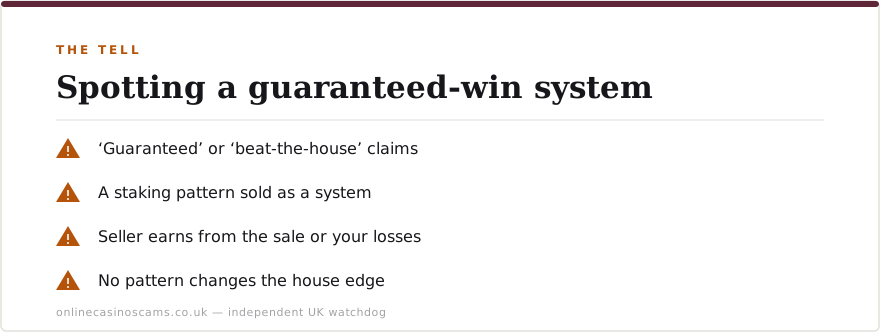
Spotting a guaranteed-win system: ‘Guaranteed’ or ‘beat-the-house’ claims; A staking pattern sold as a system; Seller earns from the sale or your losses; No pattern changes the house edge.
Section 01 / The Pitch

Why winning systems sell — and who actually profits

A winning system is sold as the thing the casino doesn’t want you to know: a rule for when and how much to bet that turns roulette, or any negative-expectation game, into a reliable income. The pitch is always wrapped around a real frustration — you’ve lost before, the wheel feels beatable, and here is a method that promises to fix it for a one-off price.

There are two ways the seller earns from that promise, and neither requires the system to work.

The sale price. An e-book, a spreadsheet, a piece of software — sold once, copied infinitely, at zero marginal cost. The buyer’s results are irrelevant to the seller’s revenue. A product that has to actually win money to make money is a hard business; a product that only has to be bought is an easy one.

Affiliate commission on your losses. This is the more profitable model and the more dishonest one. Many systems ship with a recommendation — sometimes a requirement — to play at a specific casino through a referral link. Affiliate deals in this market frequently pay the referrer a share of the player’s net losses for the lifetime of the account. So the seller is paid more the more the system loses your money. A genuinely winning system would bankrupt that arrangement. The incentive points the opposite way to the promise.

Hold those two facts together and the product reveals itself: the seller wins on the sale, wins again on your losses, and never has to deliver the one thing advertised.

Section 02 / The Martingale

The Martingale, worked through honestly

The Martingale is the system underneath almost every “guaranteed” roulette method ever sold. The rule is simple: bet on an even-money outcome (red/black, odd/even), and every time you lose, double your stake. When you eventually win, you recover every previous loss plus your original profit — then start again at the base stake.

On paper it looks unbreakable, because a win always comes “eventually”. The problem is what a losing streak actually costs you on the way there. Starting from a £5 base stake, here is the doubling progression and the cumulative amount you have wagered:

Round Outcome Stake this round (£) Cumulative outlay (£)
1Loss55
2Loss1015
3Loss2035
4Loss4075
5Loss80155
6Loss160315
7Loss320635

Read the bottom row. Seven consecutive losses have cost you £635 staked — to chase the original £5 profit. The eighth bet, to keep the system alive, would be £640. The numbers double every round, so the outlay grows faster than almost anyone’s intuition expects.

Now the two walls the Martingale always hits. First, the table limit: every roulette table caps the maximum bet, and a doubling sequence reaches that cap in a handful of rounds — at which point you are forbidden from placing the bet that would recover your losses. Second, the finite bankroll: nobody has unlimited money, and the sequence is engineered to demand exponentially more of it. A streak long enough to break you is not a freak event; on a wheel that keeps spinning, it is a certainty waiting for its turn. The Martingale doesn’t reduce your risk of a big loss — it concentrates it into one rare, catastrophic streak, then guarantees that streak eventually lands.

Section 03 / The Edge

Why no staking pattern beats the house edge

Here is the part the systems can never get around, and it isn’t an opinion — it’s the design of the game. The house edge is built into every single bet, and a betting system only changes when and how much you bet. It never changes the odds of the bet itself.

Take European roulette. There are 37 pockets (0–36). A straight-up bet on a single number has true odds of 36-to-1 — but the casino pays it at 35-to-1. That gap is the entire trick: you are paid as if the zero didn’t exist, and the zero is exactly why the casino profits. On the European wheel that works out to a house edge of 1/37, or about 2.7% of every amount staked, on average, regardless of which numbers or colours you pick.

A staking system is just a recipe for sequencing bets. Bet big after a loss, bet small after a win, follow a fancy progression — it makes no difference to the underlying arithmetic, because each spin is independent and each spin carries the same 2.7% edge against you. Add up a string of bets each carrying that edge and the expected result is a loss proportional to your total turnover. Systems that promise to “overcome” this are promising to make a string of negative-expectation bets sum to a positive expectation. It cannot be done, because addition doesn’t work that way. All a system can ever do is rearrange the timing and size of the losses — never erase them.

Section 04 / The Bot Variant

The “automatic winning system” and roulette bots

The newest packaging is software. An “automatic winning system” or roulette bot is sold as automation: install it, point it at an online casino, and let it place the bets for you while you sleep. The marketing leans on the word automatic as if mechanising a losing strategy could somehow turn it into a winning one.

It can’t. A bot is only ever the executor of a staking rule — almost always the Martingale or a close relative — and it inherits every flaw of that rule, faster and with less hesitation than a human would show. Automating a broken idea doesn’t fix the idea; it just lets you lose money around the clock without the friction of having to click.

Two extra problems ride along with the software version. First, these tools are frequently bundled with referral links to specific casinos — and those casinos are frequently unlicensed for the UK, which means no Gambling Commission protection, no ADR scheme and often no realistic route to a withdrawal. Always run the recommended operator through the register before depositing a penny; the check-a-licence walkthrough shows how. Second, casinos prohibit automated play in their terms; a bot that does start winning is the surest way to have an account frozen and the balance voided.

Section 05 / The Escalation

How the system-seller scam escalates

The e-book is rarely the end of it. The system-seller scam is built to climb, because each rung extracts more than the last from a buyer who has already shown they’ll pay.

It usually runs in stages. The e-book or software gets you in cheaply and establishes the seller as an authority. The “VIP signal group” follows — a paid Telegram or Discord channel selling live picks, “verified” results and the sense that you’re inside a winning circle. This is the same survivorship machinery that powers the wider tipster economy: broadcast picks to a crowd, keep the lucky winners visible as proof, charge everyone for access. Then comes the real payday — the push to deposit at the seller’s partner casino, through the referral link that pays them a cut of your losses. By the final rung you’re funding the seller three times over: the purchase, the subscription and the lifetime commission on everything you lose.

The casinos on the end of those referral links are exactly the kind that turn up on our register. Before you act on any seller’s recommendation, check the operator on the blacklist and on the official register — a system seller steering you toward an unlicensed site is steering you toward somewhere with no obligation to ever pay you back.

Section 06 / What Actually Helps

What actually reduces your losses

No method makes a negative-expectation game positive. But the gap between “beat the casino” (impossible) and “lose less and stay in control” (entirely possible) is where honest advice lives. Three things genuinely move the needle:

  • Choose lower-edge bets. Not all bets carry the same edge. European single-zero roulette (2.7%) is meaningfully kinder than American double-zero roulette (which adds a second green pocket and roughly doubles the edge). Game choice can’t make you a winner, but it changes how fast a fixed bankroll erodes.
  • Set deposit limits before you play, not after. Every UKGC-licensed operator must offer deposit and loss limits. Set them at sign-up, low, and treat them as a ceiling rather than a target. A limit you set while calm protects you from the version of you chasing a loss.
  • Treat gambling as entertainment spend. Budget it like a cinema ticket — money you expect not to see again, capped at what you can comfortably lose. The moment it becomes a strategy for making money, the maths is already against you.

If you’re trying to claw back what a system or a rogue casino has already taken, that’s a different problem with its own routes — start with the safety guides.

Section 07 / Questions

Frequently asked questions

Common questions about roulette and betting systems, and why no staking pattern beats the house edge.

Do roulette systems work?

No. Every roulette system only changes when and how much you bet — it never changes the odds of the individual bet, which carry the house edge regardless. Over any run of spins the expected result is a loss proportional to how much you’ve staked. Systems rearrange the timing of losses; they don’t remove them.

Does the Martingale work?

Not in practice. The doubling progression demands exponentially more money each round — from a £5 base, seven straight losses cost £635 staked to chase a £5 profit. Table limits and a finite bankroll both cut the sequence short before recovery, and on a wheel that keeps spinning a streak long enough to break you eventually arrives.

What is the safest roulette strategy?

No strategy beats the edge, so “safest” means losing more slowly and staying in control: pick lower-edge bets such as European single-zero roulette over American double-zero, set deposit and loss limits before playing, and treat the budget as entertainment spend you expect not to recover.

Are there betting systems that actually work?

Not against a negative-expectation game. A system would have to make a series of bets, each carrying the house edge, sum to a positive expectation — which addition doesn’t allow. Any product claiming a “system that works” is selling the sale itself, not a working method.

Why do system sellers show winning screenshots?

Screenshots are trivial to cherry-pick or fabricate, and a short-term winning session is entirely possible by chance even with a losing method. A genuine record would be a complete, timestamped log of every bet — wins and losses — not a gallery of good moments. The absence of that complete record is the answer.

Is there a legal guaranteed way to win at roulette?

No. The game is built so that every bet carries a house edge — on European roulette, true odds of 36-to-1 paid at 35-to-1. Anything advertising a guaranteed win is either misunderstanding the maths or deliberately misrepresenting it.

What is an automatic winning system?

It’s software sold as automation — a bot that places bets for you according to a staking rule, usually the Martingale. Automating a losing strategy doesn’t make it win; it just executes the same losing maths faster, and the tools are often bundled with referral links to unlicensed casinos.

Can software predict roulette?

No software can predict the outcome of a fair spin in an online casino, where results come from a random number generator with no physical pattern to read. “Prediction” tools are marketing wrapped around the same broken staking logic, and they carry the added risk of steering you to a partnered, frequently unlicensed, operator.

Why do casinos allow system players?

Because system players are profitable customers. A staking pattern doesn’t reduce the house edge, so over time a player diligently following a system loses at the same expected rate as anyone else — often faster, because systems tend to increase total turnover. The casino has no reason to stop someone playing in a way that increases its expected take.

I bought a system — can I get a refund?

If you bought through a mainstream marketplace or with a card, ask the seller first and then your card provider about a chargeback; UK consumer protections and card-scheme rules sometimes apply, and time limits matter. Many sellers operate offshore or anonymously and won’t respond — keep every receipt and message, and report the seller to Action Fraud. The safety guides cover the practical routes.

Section 08 / Keep Reading

Related reading

Before you trust any “system”, check the casino behind it.

Most winning systems end with a nudge to deposit somewhere specific. Run that operator through the register first — and learn the sixty-second check that filters out the rogue sites these schemes steer you toward.