ONLINE CASINO SCAMS The Independent UK Watchdog
The Money Won’t Leave

Withdrawal traps: when a casino won’t pay your winnings

Of every complaint this site reads, the most common is also the simplest to state: the player won, and the money won’t come out. The deposit cleared in seconds; the withdrawal sits in “pending” for weeks behind a document loop that never quite closes. A withdrawal trap is the scam where the casino never has to refuse you outright — it just makes paying you so slow, so conditional and so exhausting that most players give up. This guide names the four stalling tactics, the no-verification bait that flips the moment you win, the pay-to-withdraw demand that is always a scam, and the payment rails designed to remove your bank from the picture.

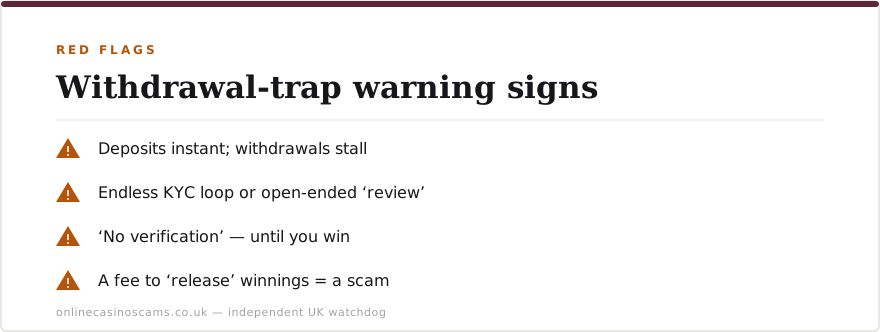
Withdrawal-trap warning signs: Deposits instant; withdrawals stall; Endless KYC loop or open-ended ‘review’; ‘No verification’ — until you win; A fee to ‘release’ winnings = a scam.
Section 01 / The Definition

The withdrawal trap, defined

A withdrawal trap is the deliberate obstruction of a payout you are owed. It is not a single act but a pattern: deposits are frictionless and instant, while withdrawals meet delay after delay, each one individually defensible as “procedure”. The casino rarely says no. Saying no is a decision a regulator can examine. Instead it stalls — a fresh document request here, a “security review” there, a minimum threshold you somehow never reach — until the player either accepts a reduced settlement or abandons the balance entirely. Abandonment is the goal, because an abandoned withdrawal costs the operator nothing and leaves no formal refusal on the record.

This is the mechanism behind the term players use most often: the deposit-only casino, where money moves in one direction by design. Some sites running this trap are outright fakes that never intend to pay anyone. Others are real operators — sometimes even licensed ones — that pay small withdrawals to keep reviews mixed, but stall anything large enough to matter. The tactics below are the same in both cases; only the recourse differs, which is why section six turns on a single question: is the operator licensed by the Gambling Commission or not?

Section 02 / The Stalling Playbook

The four stalling tactics

A withdrawal trap is built from a small, repeatable set of moves. Recognise them individually and the pattern stops looking like bad luck and starts looking like a system.

  • The KYC loop. Know-Your-Customer checks are a legitimate, legally required part of gambling — but a rogue operator weaponises them. Documents are requested one at a time rather than all at once; each is accepted, then a further one is demanded; an upload is declared “unclear” and must be resubmitted; the clock resets with every round. Genuine verification asks for a defined set of documents once and confirms them within a stated window. A loop with no end is not verification — it is a stall wearing verification’s clothes.
  • Fabricated security holds. The account is placed under “review” or “additional checks” with no completion date and no specific reason. The hold appears precisely when a withdrawal is requested and lifts only if the player deposits again or simply gives up. A real fraud review has a scope and an end; a fabricated one is open-ended on purpose.
  • Shifting minimum and maximum limits. A withdrawal minimum that is suddenly higher than your balance; a daily or monthly maximum so low that a real win would take years to pay out in instalments; per-transaction fees that erode each slice. None of these refuse the payout — they ration it into irrelevance.
  • The reversed withdrawal. A pending withdrawal is quietly cancelled and the funds returned to the playable balance, sometimes with a prompt to “keep playing”. The intent is obvious: keep the money in the system long enough for ordinary variance to claw it back. Reviewers of brands on our register describe exactly this — payouts reversed to balance rather than paid.

The tactics share one tell: each delay is framed as something the player must fix. Real obstacles have a defined finish line. A trap moves the line every time you reach it.

Section 03 / The No-KYC Bait

The “no verification” bait-and-switch

One of the most effective hooks in the unlicensed market is the promise of no KYC — “no documents”, “instant play”, “anonymous accounts”. It answers a genuine frustration: verification on regulated sites can be slow and intrusive. So the pitch lands. The problem is that it is structurally a trap, and the trap closes only when you win.

The bait-and-switch runs in two stages. On the way in, no checks: depositing is instant and anonymous, exactly as advertised, which is precisely how the money gets onto the platform. On the way out — the moment a withdrawal is requested, and especially a large one — the same site that promised no verification suddenly demands invasive identity documents: photo ID, proof of address, source-of-funds evidence, sometimes a held selfie. The requirements are deliberately heavy because the goal is not to verify you; it is to find a reason to delay or void the payout. A document that doesn’t match a hastily created “anonymous” account is then grounds for confiscation.

The honest reading is that there is no such thing as a no-KYC win. A site that lets you deposit without checks is not protecting your privacy — it is removing the regulatory layer that, on a licensed site, forces verification to happen up front and be done with. “No KYC” means the verification has merely been moved to the worst possible moment, with the worst possible motive.

Section 04 / Pay-to-Withdraw

The pay-to-withdraw demand is always a scam

This one deserves a sentence on its own, because it is the clearest red line in the whole subject: no legitimate casino ever asks you to pay money in order to take money out. If a payout is conditional on a payment from you, the operation is a scam, without exception.

The demand arrives dressed in plausible language. A “withdrawal fee” or “release fee” that must be paid before the winnings are sent. A “verification deposit” to “confirm the account is real”. A “tax” or “insurance” payment to “unlock” a large win. An “anti-money-laundering bond” refundable later. Every version inverts how money works: a real withdrawal is deducted from your balance and sent to you, never funded by a new payment from you. Genuine verification costs you documents and time — never a transfer.

The reason the demand works is psychological. The player can see a large balance on screen and is asked for a comparatively small sum to release it; the maths feels obvious. But each fee paid simply triggers the next — a bigger “tax”, a final “clearance charge” — until the player runs out of money or patience, having added real losses on top of a balance that was never going to be paid. The rule has no exceptions worth remembering: the instant a withdrawal requires a payment from you, stop paying and start documenting.

Section 05 / The Payment-Rail Trap

Untraceable payments: removing your bank from the equation

Closely tied to the withdrawal trap is the choice of how you pay in the first place — because the payment rail decides whether you have a route back. Scam operators show a strong, consistent preference for methods that cannot be reversed, and the preference is not a coincidence.

The pattern to watch: a site that quietly discourages or refuses ordinary debit cards and instead pushes cryptocurrency, gift cards / vouchers, or transfers through unofficial channels. The pitch is “faster”, “lower fees” or “more private”. The real function is to strip out the one party that can claw money back on your behalf: your bank. A card payment can be disputed through a chargeback; a crypto transfer or a redeemed voucher generally cannot be undone by anyone. When a site that won’t take your card insists on coins, it is not offering convenience — it is removing your strongest recovery route before you have realised you need one.

This is also why a wave of fake “crypto casinos” exists at all: anonymous wallets, irreversible transactions and offshore hosting let an operator take deposits with almost no trail. Some are invented platforms with fabricated licences and AI-generated branding; others vanish entirely once deposits accumulate. The defence is mechanical rather than technical: pay by a method that can be reversed, treat any pressure toward irreversible rails as a red flag in itself, and never deposit by crypto or voucher at a site you have not verified on the Gambling Commission register.

Section 06 / Licensed vs Unlicensed

Why the licence decides everything here

A withdrawal trap at a licensed casino and the same behaviour at an unlicensed one are, to the player, identical experiences — but they are completely different problems, because only one of them has an exit.

At a UKGC-licensed operator, deliberate withdrawal obstruction breaches licence conditions. You have a formal complaints route, an independent ADR adjudicator, and ultimately a regulator that can and does act. This is not theoretical. Several licensed brands on our register carry sustained complaint patterns built around exactly these tactics — for example, Monster Casino, whose operator was fined £1m by the Gambling Commission in 2025 amid a review record dominated by withheld-winnings reports. A licence did not prevent the behaviour; what it provided was the enforcement that followed it. That is the entire value of a licence: not a guarantee of good conduct, but a guarantee of recourse when conduct is bad.

At an unlicensed site, none of that exists. There is no ADR scheme, no licence to threaten, no regulator with jurisdiction over an offshore shell. Reviewers of operators such as Winner Casino — Malta-licensed only, with no Gambling Commission entry found — describe withdrawal delays measured in months and payouts reversed to balance, with no UK authority able to compel payment. This asymmetry is the single most important reason to check the licence before depositing, not after a withdrawal stalls. The trap is far easier to avoid than to escape.

Section 07 / If You’re Stuck

Withdrawal stalled already? The order of play

If a payout is being obstructed, your route depends on whether the operator is licensed — and the steps are most effective taken in order.

  • Document everything now. Screenshot the balance, the pending withdrawal, every support message and the exact terms as they appear today. Terms pages change; your evidence should be fixed before they do.
  • For a UKGC-licensed brand, work the complaints ladder. Complain to the operator in writing first, then escalate to its named ADR scheme if the response is inadequate, then the regulator. The sequence matters — the complaints and ADR guide walks through each stage.
  • Ask your bank about a chargeback. If you funded the account by debit or credit card, a chargeback may recover deposits — but time limits apply, so ask early. The recovery guide covers what realistically works.
  • For an unlicensed site, treat it as fraud, not a dispute. There is no ADR route; report it to the Gambling Commission and to Action Fraud, and pursue the bank chargeback as your main realistic channel.
  • Never pay to be paid. If “releasing” your winnings requires a fee, tax or verification deposit, that is the scam confirming itself — stop sending money immediately.

One more warning, because the timing is predictable: once a withdrawal complaint becomes visible — a review, a forum post — “recovery agents” tend to appear offering to retrieve your funds for an upfront fee. They are the second scam, not the solution to the first.

Section 08 / Questions

Frequently asked questions

Why withdrawals get blocked, what KYC can and can’t require, and how to get a stalled payout moving.

Why won’t the casino let me withdraw my winnings?

The common cause is a deliberate stall rather than a technical problem: an endless KYC loop, an open-ended “security review”, a withdrawal minimum suddenly above your balance, or a pending withdrawal quietly reversed to your playable balance. Each delay is framed as something you must fix, but the finish line keeps moving. At a licensed operator you have a complaints and ADR route; at an unlicensed one, recovery is far harder.

Is it normal for a casino to ask for ID before paying out?

Yes — identity verification (KYC) is legally required, and a legitimate operator asks for a defined set of documents once and confirms them within a stated window. What is not normal is documents requested one at a time, repeated “unclear” rejections, or fresh requirements appearing only after you try to withdraw. A loop with no end is a stalling tactic, not genuine verification.

Should I use a casino that advertises “no KYC” or anonymous accounts?

No. “No KYC” usually means the verification has been moved to withdrawal time, with the motive of finding a reason to void a payout. Sites take anonymous deposits instantly, then demand invasive documents the moment you win. A licensed UK casino verifies up front and is done with it; the absence of checks at deposit is a warning sign, not a privacy feature.

A casino is asking me to pay a fee to release my winnings — is that real?

No. No legitimate casino ever requires a payment from you to release a withdrawal. “Release fees”, “verification deposits”, “taxes” and “insurance bonds” to unlock a win are all the same advance-fee scam: each payment triggers the next, and the balance is never paid. Stop sending money the moment a payout is made conditional on a payment.

Why do scam casinos prefer crypto and gift cards?

Because those payments can’t be reversed. A debit or credit card payment can be disputed through a chargeback; a cryptocurrency transfer or a redeemed voucher generally cannot be undone. When a site refuses cards and pushes crypto or vouchers as “faster” or “more private”, it is removing your bank — your strongest recovery route — from the equation.

What is a deposit-only casino?

A site where money effectively moves one way: deposits process in seconds while withdrawals never complete. Some are outright fakes with no intention of paying anyone; others are unlicensed operators that pay small amounts to keep reviews mixed but stall anything substantial. Both rely on the same playbook of delays, document loops and reversed withdrawals.

Can a UKGC-licensed casino block my withdrawal?

It can delay one — and several licensed brands on our register carry documented complaint patterns around withdrawals and verification. The difference is recourse: deliberate obstruction breaches licence conditions, so you can complain to the operator, escalate to its ADR scheme, and involve the regulator. Operators have been fined seven figures over exactly this. The licence guarantees a route, not good behaviour.

How long can a casino legitimately take to pay a withdrawal?

There is no single legal figure, but a licensed operator should process within a reasonable, stated timeframe — typically a few working days once verification is complete, plus your payment provider’s own time. Open-ended “pending” with no completion date, or a clock that resets each time you supply a document, is the warning sign — not the raw number of days.

What should I do if my withdrawal has been stuck for weeks?

Screenshot the balance, the pending withdrawal, every message and the current terms. For a licensed brand, complain in writing, then escalate to its ADR scheme, then the regulator. Ask your bank about a chargeback early, as time limits apply. For an unlicensed site, report it to the Gambling Commission and Action Fraud and rely on the chargeback. Never pay any fee to “release” the funds, and ignore recovery agents who contact you afterwards.

Section 09 / Keep Reading

Related reading

Check how a casino pays out before you put money in.

Withdrawal traps are far easier to avoid than to escape. Verify the licence, pay by a method your bank can reverse, and read a brand’s complaint record first — then know the complaints route if a payout still stalls.