ONLINE CASINO SCAMS The Independent UK Watchdog
The Loophole

Non-GamStop casinos: the self-exclusion loophole explained

Search for a way around a gambling block and an entire market is waiting: “non-GamStop” casinos, sold on the promise of no limits, no checks and no self-exclusion register. It is one of the few corners of online gambling that advertises its lack of safeguards as the product. This guide is not a list of those sites and never will be — it explains what the label actually means, what UK protections you surrender the moment you deposit at one, why this market concentrates the worst withdrawal and bonus practices we document, and what to do instead if a block you set is now the thing you want to break.

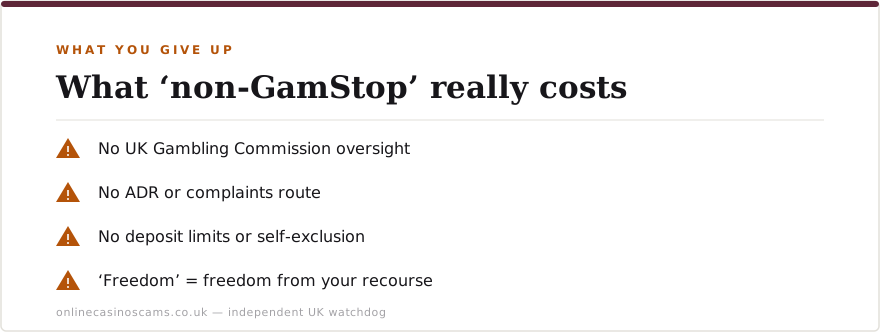
What ‘non-GamStop’ really costs: No UK Gambling Commission oversight; No ADR or complaints route; No deposit limits or self-exclusion; ‘Freedom’ = freedom from your recourse.
Section 01 / What GamStop Is

What “non-GamStop” is defined against

GamStop is the free national self-exclusion scheme for Great Britain. You register once, choose a period — six months, one year or five years — and every operator licensed by the Gambling Commission is required to block your access for that time. It is not optional for the operator: participation in GamStop is a condition of holding a UK licence. That single fact is what creates the term “non-GamStop”, because the only way a casino can ignore your self-exclusion is by not holding a UK licence at all.

So the phrase is more revealing than it looks. “Non-GamStop” does not describe a feature a casino has added; it describes a regulator a casino has avoided. Every site marketed this way operates outside the UK licensing system, typically from an offshore jurisdiction, precisely so the self-exclusion rule — and everything else in the UK rulebook — does not apply to it. If you are new to the scheme itself, our explainer on what GamStop is and how to register covers the mechanics; this page is about the market that defines itself by escaping it.

Section 02 / The Loophole Pitch

How the loophole is sold

The marketing is remarkably consistent, and it is built almost entirely on euphemism. The recurring sales words are freedom, flexibility, no restrictions and no questions asked. Each is a softer way of describing the removal of a protection: “freedom” from deposit limits, “flexibility” around verification, “no questions” about affordability or self-exclusion.

The pitch is engineered to reach people at a specific moment. These sites rank for searches like “casinos not on GamStop” and “how to bypass self-exclusion” — searches almost nobody runs casually. Affiliate sites, social posts and AI-written “best non-GamStop casino” lists then funnel that traffic onward, often for commission paid by the very operators they recommend. The result is a polished layer of apparent endorsement sitting on top of a market whose defining characteristic is that no UK authority stands behind any of it. The bait, as with most gambling scams, is an answer to a real frustration — slow withdrawals, intrusive checks, a block you now regret — repackaged as liberation.

Section 03 / What You Give Up

The protections you surrender at the door

Depositing at a site outside UK licensing is not a small administrative difference. It removes, at a stroke, the entire framework that makes the regulated market recoverable when something goes wrong:

  • No Gambling Commission oversight. The operator answers to no UK regulator. There is no licence to suspend and no UK authority with jurisdiction to compel it to act.
  • No ADR route. Licensed brands must offer access to an independent alternative-dispute-resolution adjudicator. Outside the system, that escalation ladder simply does not exist — a withheld payout has nowhere to go.
  • No mandated player protections. Deposit limits, affordability checks, reality checks and the self-exclusion you set are all UK licence conditions. An unlicensed site is under no obligation to honour any of them.
  • No game-testing guarantee. UK-licensed games must pass independent testing. Unlicensed sites face no such requirement, which is where rigged and pirated games concentrate.
  • Weaker recovery if it all goes wrong. With no licence and no ADR, a disputed deposit usually comes down to a bank chargeback alone — and these sites tend to push the irreversible payment methods that remove even that.

The honest summary: a UK licence is not bureaucracy you are cleverly skipping. It is the thing that gives a payout dispute an exit. Trading it away for “freedom” means trading away your recourse first.

Section 04 / The Scam Overlap

Why the rogue operators cluster here

There is a structural reason the non-GamStop market overlaps so heavily with the scams documented across this site: it is the part of the industry that has already opted out of accountability. An operator willing to ignore self-exclusion has, by definition, accepted operating without a UK licence — which is also the precondition for every other corner-cutting practice we track.

So the same sites recur across our taxonomy. The withdrawal trap thrives here because there is no ADR adjudicator to escalate to. The bonus trap runs without restraint because no regulator polices the terms. Rigged or pirated games appear because nothing requires independent testing. And cloned and invented platforms shelter here because an offshore, often crypto-funded operation leaves almost no trail. None of this means every site outside GamStop is a deliberate fraud — but it does mean the market selects for operators who have already chosen to sit beyond the reach of UK enforcement, and that is exactly the population in which the worst behaviour is found.

Section 05 / Who It Targets

The people the pitch is aimed at

This is the part the “freedom” framing is designed to obscure. The audience for a way around self-exclusion is, overwhelmingly, the people who chose to self-exclude — and the most common reason to do that is to interrupt gambling that had become harmful. The marketing reaches its target at the precise moment the original safeguard is doing its job, and reframes that safeguard as an obstacle to be removed.

That is what makes the loophole different in kind from the other scams here. A withdrawal trap takes a player’s money; a non-GamStop pitch aimed at someone in active self-exclusion can undo the one decision that was protecting them, and then expose them to every financial scam in the market besides. The combination — heightened vulnerability, removed protections, concentrated rogue operators — is why this site treats the “non-GamStop” category as a documented harm pattern rather than a neutral product choice. The block you set was the protection. The pitch to break it is the risk.

Section 06 / If You’re Tempted

Self-excluded and tempted to bypass it?

If you registered with GamStop and are now looking for a way around it, that urge is common and it is exactly the situation the scheme exists to hold against. A few practical points are worth more than any warning:

  • The block working is the system working. Finding regulated sites closed to you is GamStop doing precisely what you asked it to. The discomfort is temporary; it is not a malfunction.
  • Add the gaps GamStop doesn’t cover. GamStop only covers UK-licensed operators. Bank card gambling blocks (offered free by most UK banks) and blocking software such as Gamban close off much of what sits outside it, including the non-GamStop market.
  • Talk to free, confidential support. GamCare runs the National Gambling Helpline on 0808 8020 133, open 24 hours, alongside BeGambleAware. There is no cost and no judgement, and they deal with exactly this moment every day.
  • Don’t hand the moment to a scammer. Searching for a bypass is also how you surface the market most likely to take your money and least able to be held to account. The site selling you “freedom” has no reason to protect you and every incentive not to pay you.

If money has already gone to a site like this and a withdrawal is now being blocked, treat it as the withdrawal trap it usually is: document everything, ask your bank about a chargeback quickly, and ignore any “recovery agent” who appears afterwards offering to retrieve it for a fee.

Section 07 / Questions

Frequently asked questions

What “non-GamStop” really means, what it costs you in protection, and safer routes if you’re tempted to bypass a block.

What does “non-GamStop” actually mean?

It means the casino is not part of GamStop’s national self-exclusion scheme — and because participation is a condition of holding a UK licence, that is only possible for sites operating outside UK licensing, usually offshore. “Non-GamStop” describes a regulator the site has avoided, not a feature it has added.

Are non-GamStop casinos legal in the UK?

They are not licensed by the Gambling Commission to offer gambling to British consumers, so they operate outside the UK regulatory framework. The practical consequence for a player is the one that matters: no UK oversight, no ADR route and no licence that can be acted against if something goes wrong.

Why are these sites considered higher risk?

Because the category has already opted out of accountability. With no UK licence there is no mandated game testing, no enforced bonus or affordability rules and no ADR adjudicator — the exact conditions in which withdrawal traps, bonus traps and rigged games concentrate. Not every such site is a deliberate fraud, but the market selects for operators beyond UK enforcement.

Can I recover money lost at a non-GamStop site?

It is harder. There is no ADR scheme and no UK regulator with jurisdiction, so a bank chargeback on a card deposit is usually the main realistic route — and these sites often push irreversible crypto or voucher payments that remove even that. Document everything, ask your bank quickly, and ignore any recovery agent who contacts you for an upfront fee.

How can I block non-GamStop sites as well?

GamStop only covers UK-licensed operators, so combine it with the gaps it leaves: most UK banks offer a free gambling block on your card, and blocking software such as Gamban covers gambling sites at device level, including those outside GamStop. Together they close off most of the non-GamStop market.

I self-excluded but I’m tempted to gamble again — what should I do?

That urge is common and the block doing its job is the system working as intended. Free, confidential support is available now: GamCare’s National Gambling Helpline on 0808 8020 133 is open 24 hours, alongside BeGambleAware. Adding bank and software blocks closes the gaps, and reaching out costs nothing.

Are the “best non-GamStop casino” review lists trustworthy?

Treat them with caution. Many are affiliate pages or AI-generated lists paid for by the operators they recommend, which manufactures a layer of apparent endorsement over a market no UK authority stands behind. An endorsement from a site earning commission on your deposit is marketing, not a safety check.

Does this site list non-GamStop casinos?

No. We document how the loophole works and what it costs you in protection, but we do not list, link to or recommend sites that operate outside UK self-exclusion. The purpose of this page is the opposite of those lists: to explain why the category is a documented harm pattern, not a product to choose between.

Section 08 / Keep Reading

Related reading

“Freedom” from the rules means freedom from your recourse.

A UK licence is what gives a payout dispute an exit. Sites that ignore self-exclusion have given that up — and the block you set was the protection, not the problem.