ONLINE CASINO SCAMS The Independent UK Watchdog
Scam Type / Tipsters

Betting tipster scams: the survivorship machine, explained

Betting tipster scams look like generosity — free picks, a friendly channel, screenshots of green slips — and the generosity is exactly the bait. Behind it sits a simple, unsexy machine: send enough different predictions to enough people, and pure chance manufactures a small group who saw nothing but wins. Those survivors become the testimonials that sell the rest. This guide takes the machine apart, shows you the arithmetic with real numbers, and explains what an honest record would actually look like.

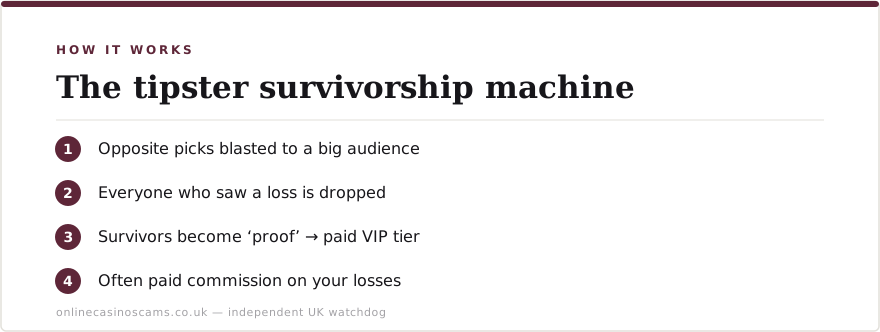
The tipster survivorship machine: Opposite picks blasted to a big audience; Everyone who saw a loss is dropped; Survivors become ‘proof’ → paid VIP tier; Often paid commission on your losses.
Section 01 / The Economy

The tipster economy: where the money really comes from

Most tipster operations start with a free channel — Telegram, Instagram, Discord — because reach is the raw material. The free tier exists to build an audience, not to give value away. Above it sits a paid “VIP” tier promising the picks that supposedly win, and the funnel from free to paid is the entire commercial design.

But subscriptions are only half the income. The larger and quieter half is affiliate commission: many channels are paid by gambling operators for every follower they send who signs up and bets. That payment is typically tied to the follower’s losses — the more you lose, the more the channel earns. Read that twice, because it inverts the relationship the channel performs. A tipster on a loss-based affiliate deal is financially better off when its audience loses, which is the opposite of the partnership the “we’re in this together” messaging implies.

So the honest summary of the business model is: charge people for picks, and get paid again when those picks lose at a partnered casino. Neither revenue stream requires the tips to actually win. That single fact explains almost everything else on this page.

Section 02 / The Survivorship Machine

The survivorship machine, with the arithmetic

This is the mechanic that makes the testimonials look real. You don’t need to predict anything to produce people who have “seen you win every time” — you only need a large enough audience and the willingness to tell different people different things. Here is the worked example, on a coin-flip market where each pick has a roughly even chance.

Start with 1,000 followers. Split them into two halves and send each half the opposite pick. One pick wins; whichever half received it has now seen one correct call. Drop the half that saw a loss and repeat with the survivors, halving again each round:

Round People still seeing only wins How it’s produced
Start 1,000 The full audience, before any pick is sent.
Round 1 500 500 were told the winning side, 500 the losing side. The 500 losers are dropped.
Round 2 250 The 500 survivors are split again; the 250 who saw the second win continue.
Round 3 125 The 250 are split once more; 125 have now seen three straight correct calls.

After three rounds, 125 people have watched the tipster call three winners in a row — not because the tipster predicted anything, but because 1,000 ÷ 2 ÷ 2 ÷ 2 = 125 by construction. To each of those 125, the channel looks uncanny. They are the testimonials. The other 875 saw at least one loss, drifted away, and stayed silent — which is why you only ever encounter the survivors.

The losers churning quietly is the other half of the machine. A scam doesn’t need to hide its failures if its failures remove themselves; disappointed followers simply leave, taking the evidence with them. What remains on the channel is a curated wall of wins that was statistically guaranteed from the start. Run the split with 10,000 followers instead of 1,000 and you manufacture a far larger group of true believers — the maths scales as cleanly as the deception.

Section 03 / Fixed-Match Theatre

Fixed-match sellers: why “insider” offers are theatre

A particular subspecies sells “fixed matches” — supposedly pre-arranged results known in advance. Treat the offer as theatre, because the economics make no sense. Genuine match-fixing is a serious criminal conspiracy involving players or officials and large, discreet sums; nobody who could actually arrange it would retail the outcome to strangers on Telegram for a £50 subscription. The premise refutes itself: if the result were truly guaranteed, the seller would simply bet it, not sell it.

What the “fixed match” offer is really selling is a script. The first tip is often free, or framed as a no-risk demonstration, and — by the survivorship mechanic above, or simply by picking a likely favourite — it “wins”. That win is the hook. The escalation follows: now that you’ve seen the proof, the next fixed match costs a fee, then a larger fee for a “guaranteed multi”, then a deposit at a specific bookmaker, with the losses always blamed on you breaking a rule (wrong stake, wrong timing) so the next, pricier tip can be sold. The theatre exists to walk you up that staircase one believable step at a time.

Section 04 / The Casino Funnel

The casino-funnel variant

Some channels barely pretend to be about tips at all — their real function is to push followers toward specific casinos. The picks are filler; the recurring message is “place it here, use this link, claim this bonus”. When the destination is an unlicensed operator, the tipster channel is acting as a marketing front for exactly the kind of site documented on our register, and the loss-based affiliate commission described earlier is the whole point.

This variant frequently overlaps with the ad-delivered clone problem. A flashy ad or a channel link can land you on a cloned or invented casino site dressed up as a known brand, where the “VIP bonus” your tipster promised becomes a deposit you can’t withdraw. The defence is the same as everywhere on this site: don’t reach a casino through a link someone sent you — verify the operator independently first. A tip that comes bundled with a specific deposit destination is an advert wearing analysis as a costume.

Section 05 / Synthetic Endorsements

Deepfake and AI-faked endorsements

The newest layer on the tipster machine is manufactured credibility. Where a channel once leaned on cropped win slips, it can now borrow a famous face. AI-generated video — deepfakes — lets a scam put words into the mouth of someone the audience already trusts, and the technology has reached gambling advertising in earnest. The Gambling Commission has publicly warned about it and moved to take down offending apps; in one widely reported case, AI was used to fake a Sky News journalist into a video advert endorsing a gambling app, routing viewers toward an unlicensed offshore casino. Footballers, broadcasters and well-known entrepreneurs have all been impersonated this way, none of them having said any such thing.

The mechanism is the same survivorship-and-funnel machine described above, wearing a borrowed face. A deepfaked celebrity “reveals” a prediction app or a tipster channel; the clip spreads on social platforms where short video travels fastest; the funnel then runs exactly as it always has — free hook, paid tier, deposit at a specific operator. AI also mass-produces the supporting cast: fabricated five-star reviews, entire “news” pages, and convincing chat from bots posing as delighted members. The effect is a wall of synthetic consensus built around something that did not exist last week.

The countermeasure has not changed, which is the reassuring part. No endorsement — real or faked — alters the arithmetic on this page, and no celebrity clip is a substitute for a complete, verifiable record or a licence you have checked yourself. Treat a famous face in a betting advert as decoration, not evidence: verify the operator on the Gambling Commission register regardless of who appears to be recommending it, and assume any “they made millions with this app” video is fabricated until a verifiable record proves otherwise. A genuine edge is never sold through a celebrity testimonial.

Section 06 / Verifiable Records

What a verifiable record actually looks like

The single question that deflates almost every tipster scam is: show me the complete record. Screenshots aren’t a record — they’re a selection, and selection is precisely how the survivorship machine works. A win slip proves one win happened; it says nothing about the losses cropped out of frame.

A record worth trusting has three properties. It is timestamped before kick-off, so every pick is logged when it’s made, not curated after the result is known. It is complete, listing every tip — winners and losers — with stakes and odds, so the true strike rate and return are calculable rather than implied. And it is third-party-verifiable, published somewhere the tipster can’t quietly edit history. Independent proofing services exist for exactly this reason. A genuine, profitable tipster has every incentive to keep such a record; a scam has every incentive to show you screenshots instead. When the only “proof” is a wall of green slips, the absence of a verifiable record is the answer.

Section 07 / Recourse

Lost money to a tipster? Here’s the order of play

  1. Report the account on-platform. Telegram, Instagram and the rest have reporting routes for fraudulent financial schemes; flag the channel and any clones of it.
  2. Report to Action Fraud. Paying for tips sold on false pretences is fraud. A single report rarely acts; a pattern of them builds the case.
  3. Ask your bank about a chargeback. If you paid a subscription or a “fixed match” fee by card, a chargeback may be possible — time limits apply, so move quickly. The recovery guide covers what realistically works.
  4. Brace for the second wave. Once you’ve posted a public complaint, expect “recovery agents” to appear offering to claw your money back for a fee. They are a second scam aimed squarely at people in your position — read the recovery scams guide before you engage with any of them.

One more thing: do not chase the loss with the same tipster’s “next sure thing”. The escalation script depends on you trying to recover by doubling down, and that staircase only goes one way.

Section 08 / Questions

Frequently asked questions

How tipster and fixed-match scams work, and how to tell a genuine betting record from a fabricated one.

Are betting tipsters legit?

A small number publish verifiable, timestamped, complete records and may be genuine — but most don’t, and the absence is the answer. The scam version runs on survivorship and is frequently paid loss-based affiliate commission, meaning it earns when followers lose. Treat any tipster who won’t show a full record as marketing, not analysis.

How do tipster scams work?

They blast different predictions to a large audience, drop everyone who saw a loss, and keep the shrinking group who happened to see only wins. Those survivors become testimonials that sell paid “VIP” access, while the channel often also collects affiliate commission tied to followers’ losses at a partnered casino.

What is a fixed match scam?

An offer to sell supposedly pre-arranged results. It’s theatre: genuine match-fixing is a serious criminal conspiracy, not something retailed to strangers for a subscription. If a result were truly guaranteed, the seller would bet it rather than sell it. The “fixed match” is a script that escalates from a free hook to ever-larger fees.

Why do tipsters show winning screenshots?

Because a screenshot is a selection, not a record. Showing winning slips while cropping out losses is exactly how the survivorship machine sustains itself. A win slip proves one win happened; it says nothing about the strike rate across every pick, which is what actually matters.

Are Telegram betting groups safe?

The platform isn’t the problem; the model is. Many Telegram tipster groups run the survivorship machine or act as funnels to unlicensed casinos. A free channel that pushes a specific deposit destination is most likely an advert. Judge any group by whether it publishes a complete, third-party-verifiable record.

How can I verify a tipster’s record?

Insist on a record that is timestamped before each event, complete (every pick, with stakes and odds, winners and losers), and published somewhere it can’t be quietly edited — ideally through an independent proofing service. If only screenshots are offered, the verifiable record doesn’t exist.

Do tipsters make money from my losses?

Many do. A large share of tipster income is affiliate commission from gambling operators, frequently tied to how much the referred followers lose. On that arrangement the channel is financially better off when its audience loses — the opposite of the partnership the messaging implies.

What is a VIP signal group?

It’s the paid tier the free channel funnels you toward, promising the picks that supposedly win. The free tier exists to build reach; the VIP tier exists to monetise it. Paying for access doesn’t change the underlying maths — the house edge and the survivorship selection are unaffected by the subscription.

Can I get my subscription money back?

Possibly. If you paid by card, ask your bank about a chargeback as soon as you can, because time limits apply. Report the account on the platform and to Action Fraud as well. The recovery guide on this site walks through the realistic routes in order.

Are AI prediction bots real?

“AI prediction” is usually the survivorship machine with a modern label. No model removes the bookmaker’s margin or the underlying uncertainty of sport, and a bot that genuinely beat the market would be used quietly, not sold by subscription. Apply the same test: where is the complete, verifiable record?

Are celebrity endorsements of betting apps real?

Often they are deepfakes. AI video can put an endorsement into the mouth of a footballer, broadcaster or entrepreneur who never said it — the Gambling Commission has warned about exactly this, including a faked Sky News journalist used to promote an unlicensed app. Treat any famous face in a betting advert as decoration, not evidence, and verify the operator on the register yourself regardless of who appears to recommend it.

Further Reading

Related reading

A wall of winning slips isn’t a record.

If a tipster won’t show a complete, timestamped, verifiable record, the survivorship machine is doing the work. Learn the other models that share its arithmetic — and check where its links actually lead.