ONLINE CASINO SCAMS The Independent UK Watchdog
The Stolen Login

Casino phishing and account-takeover scams

Most gambling scams want your deposit. Phishing wants something more useful: your login. A single email that looks like “customer support”, a text about a “suspicious withdrawal”, a link to “verify your account” — each is built to make you type your password into a page that isn’t the casino. Once the attacker has it, they don’t need to break anything: they simply log in as you, drain the balance, and often reuse the same password elsewhere. This guide shows the channels the messages arrive through, the tells that give them away, and the handful of habits that make a stolen password almost useless.

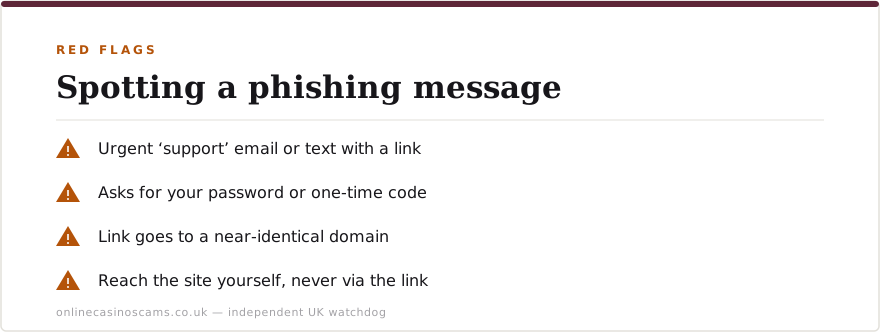
Spotting a phishing message: Urgent ‘support’ email or text with a link; Asks for your password or one-time code; Link goes to a near-identical domain; Reach the site yourself, never via the link.
Section 01 / The Definition

Phishing, in a gambling context

Phishing is the use of a fake message to trick you into handing over credentials or money. In gambling it has a specific shape, because the attacker knows two things about you that make the bait land: that you hold a balance somewhere, and that withdrawals and verification are already sources of anxiety. So the message imitates exactly the communications you half-expect — a security alert, a verification request, a withdrawal confirmation — and uses that expectation against you.

The crucial distinction from the other scams on this site is what is being attacked. A cloned site waits for you to arrive and deposit; a withdrawal trap obstructs money you have already paid in. Phishing reaches out to you, at a real account you actually hold, and steals the key to it. It does not need the casino to be a scam at all — the target is your access to a legitimate account, which is why phishing affects players at fully licensed, reputable operators just as much as anywhere else.

Section 02 / The Channels

How the messages reach you

Phishing is a delivery problem before it is a technical one. The attacker’s first job is to get a convincing message in front of you through a channel you trust:

  • Fake “support” email. Branded to match the casino, warning of a problem only you can fix — an account “locked for security”, a withdrawal “on hold”, a bonus “about to expire” — with a button to log in and resolve it. The button leads to a lookalike login page that captures whatever you type.
  • SMS and messaging apps. A short text about a “suspicious login” or a “pending payout” with a shortened link. Texts strip away most of the visual cues that expose a fake email, which is exactly why they work.
  • Fake login and “verify your account” pages. The destination behind every link above: a pixel-accurate copy of the casino’s sign-in or verification screen on a near-identical domain. Some go further and ask for the one-time code from your authenticator or SMS, in real time, so they can pass it straight to the genuine site while you watch.
  • Malicious ads and search results. Paid ads and poisoned results for a casino’s name that lead to the fake login rather than the real one — so you are phished even though you went looking for the site yourself, never having received a message at all.
  • Fake “customer support” on social media. Complain about a casino publicly and a reply may arrive from a convincing “support” account offering to help — then asking you to “confirm” your login or move to a private channel. Real support does not DM you to ask for your password.

Across every channel the pattern is the same: a trusted-looking sender, a manufactured reason to act now, and a link to a page that wants your credentials.

Section 03 / The Takeover

What happens after the password is stolen

Account takeover is the quiet part, and it is where the damage compounds. Nothing is “hacked” in any dramatic sense — the attacker simply signs in with credentials you handed over, and the account treats them as you.

From there the moves are predictable. Any cash balance is withdrawn to the attacker’s own payment details, sometimes after quietly changing the registered withdrawal method first. Stored card details may be used to top up and then move funds. Personal and identity documents uploaded for verification — exactly the data a casino holds — are harvested for use in further fraud. And because so many people reuse passwords, the same email-and-password pair is then tried automatically against banking, email and shopping accounts; the casino login was only the first door.

This is why a phishing loss is rarely contained to one site. The single most valuable thing an attacker can take from you is not a balance but a password you use in more than one place — which is also the thing the defences in the next two sections are built to neutralise.

Section 04 / The Tells

How to spot a phishing message

Phishing messages are far more uniform than they look. A short mental checklist catches the overwhelming majority before any harm is done:

  • Check the real sender and the real link, not the label. A display name is free to fake. Look at the actual email address and, on a link, the actual domain it points to — hover on a computer, long-press on a phone. A login link that doesn’t go to the casino’s exact verified domain is the whole story.
  • Manufactured urgency. “Act within 24 hours”, “your account will be closed”, “confirm now to release your withdrawal”. Urgency exists to stop you checking. A genuine operator can wait while you log in independently to verify.
  • A request for something legitimate sites never ask for. No real operator emails you asking for your password, your full card number, or a one-time authentication code. Anyone asking for a 2FA code — by message, call or chat — is trying to defeat your security, not provide it.
  • A link as the only way to act. The message insists you use its button. The defence is to ignore it entirely and reach your account the way you always do.

The single habit that collapses all of this: never log in from a link in a message. Open the casino yourself — typed address or saved bookmark — and any “urgent problem” that was real will be waiting in your account. If nothing is there, the message was the scam.

Section 05 / The Defences

The habits that make a stolen password useless

You cannot stop phishing messages being sent, but you can make them fail even when one slips through. Four habits do most of the work:

  • A unique password per site. This is the big one. If your casino password is used nowhere else, a successful phish costs you one account, not all of them. Reuse is what turns a single theft into a cascade.
  • A password manager. Beyond generating unique passwords, a manager quietly defends against phishing: it will not auto-fill your credentials on a lookalike domain, because the domain doesn’t match the one it saved. A field that won’t auto-fill is a warning worth heeding.
  • Two-factor authentication, treated as private. Enable 2FA wherever the operator offers it, and treat the codes like a password: never read one out, type one into a page you reached from a link, or share one with “support”. App-based authenticators are harder to intercept than SMS, but either is far better than none.
  • Reach accounts by your own route. Bookmark the verified login page and use it every time. The same discipline that defeats clone sites defeats phishing: if you never arrive via someone else’s link, you never land on someone else’s fake.

None of these is technical or expensive. Together they mean that even a password typed into a convincing fake page does limited damage — the account it unlocks is one, and the second factor it’s missing stops the login.

Section 06 / If You’ve Been Hit

If you’ve already entered details on a fake page

Speed limits the damage. If you think you’ve handed credentials to a phishing page, work through these in order, fastest first:

  • Change the password immediately — at the casino, and everywhere else you used the same one. Start with your email account, because whoever controls that can reset everything else.
  • Turn on or reset two-factor authentication on the affected accounts, so a stolen password alone no longer grants access.
  • Tell the casino and your bank. Ask the operator to freeze the account and check for changed withdrawal details; tell your bank if card details were exposed, and ask about stopping payments or a chargeback on anything already taken. The recovery guide covers the bank route.
  • Report it. In the UK, forward phishing emails to [email protected], report scam texts to 7726, and file with Action Fraud if money was lost. Reporting feeds the takedowns that stop the same page catching the next person.
  • Watch for the follow-up. Victims of one scam are marketed the next — expect “account recovery” or “fund recovery” offers, and treat them as the recovery scam they are.

The reassuring part: a password is replaceable in minutes, and a phishing loss caught early is usually contained to it. The lasting fix is the habits above — they turn the next attempt into a message you simply delete.

Section 07 / Questions

Frequently asked questions

How gambling phishing works, how to recognise a fake message, and what to do the moment you’ve clicked.

What is casino phishing?

It’s the use of fake messages — emails, texts, social-media replies or malicious ads — that imitate a casino’s support or security communications to trick you into entering your login on a page that isn’t the real site. The goal is your credentials rather than a deposit, and it targets players at legitimate, licensed operators just as much as at rogue ones.

How do I know if a casino email or text is fake?

Check the real sender address and the real link destination rather than the display name, and be suspicious of manufactured urgency. No genuine operator asks for your password or a one-time authentication code. The reliable test: don’t use the message’s link — open the casino yourself and see whether the “problem” actually exists in your account.

What is account takeover?

It’s when an attacker logs in with credentials you unknowingly handed over and operates the account as you — withdrawing the balance to their own details, using stored cards, and harvesting your uploaded identity documents. Because many people reuse passwords, the same login is then tried against your email, banking and shopping accounts too.

Should I ever give my one-time 2FA code to support?

Never. A one-time code exists so that only you can complete a login. Anyone who asks for it — by email, message, phone or live chat, however official they sound — is trying to get into your account in real time. Legitimate support never needs your code, because it doesn’t log in as you.

How does a password manager protect me from phishing?

It generates a unique password for every site, so one stolen login can’t unlock the others, and it ties each saved password to the exact domain. On a lookalike phishing domain it simply won’t auto-fill, because the address doesn’t match — turning a silent trap into an obvious warning sign.

Can phishing happen at a licensed, reputable casino?

Yes — phishing attacks the player, not the operator. A message can impersonate any brand, however legitimate, and a fake login page can copy any real one. Holding an account at a well-run, UKGC-licensed casino protects your deposits and your recourse, but it doesn’t stop a scammer emailing you a convincing fake; your own login habits are the defence there.

I clicked a phishing link and entered my details — what now?

Act fast. Change the password at the casino and anywhere else you reused it, starting with your email account; enable or reset two-factor authentication; tell the casino and your bank so the account can be frozen and payments stopped; and report it (forward phishing emails to [email protected], scam texts to 7726, and file with Action Fraud if money was lost). Then ignore any “recovery” offers that follow.

Where do I report a gambling phishing scam in the UK?

Forward suspicious emails to [email protected], forward scam text messages to 7726 (free), and report the account or ad on the platform it appeared on. If you lost money or had an account taken over, file a report with Action Fraud. Reporting feeds the takedown process that removes the fake page for everyone else.

Section 08 / Keep Reading

Related reading

If a message wants your login, reach the site yourself instead.

No genuine operator emails for your password or a one-time code. Open the casino by your own bookmark, keep passwords unique, and a convincing fake becomes a message you just delete.